Advancing Judicial Excellence: Consultations and Mentoring in AI, Criminal Justice, and Human Rights for the Supreme Judiciary Council of the State of Qatar


Artificial Intelligence for the Supreme Judicial Council | State of Qatar
Overview
The initiative Advancing Judicial Excellence: Consultations and Mentoring in AI, Criminal Justice, and Human Rights for the Supreme Judiciary Council of the State of Qatar is a collaborative programme between the United Nations Interregional Crime and Justice Research Institute (UNICRI) through its Centre for AI and Robotics and the Supreme Judiciary Council of the State of Qatar. Anchored in the expertise of the AI Centre, the project supports the State of Qatar’s judiciary in strengthening its capacity to navigate the evolving intersection of artificial intelligence (AI), criminal justice, and human rights and to responsibly engage with AI within the criminal justice system. This is achieved through a series of specialized, in-person training sessions for Qatari criminal court judges, held in The Hague, The Netherlands.
The initiative recognises both the opportunities and the challenges posed by AI in judicial contexts, particularly with regard to fairness, accountability, transparency and the protection of fundamental rights. The training promotes the adoption of innovative approaches that reinforce the rule of law, while ensuring that judicial decision-making remains human-centred and rights-based. To foster a comprehensive understanding of AI’s role, the curriculum also explores its broader impact on the criminal justice ecosystem, including its growing use in criminal activities and, conversely, in law enforcement investigations.
Objective and Outcomes
The project aims to enhance the capacity of Qatar's judiciary, particularly criminal judges, to address emerging challenges at the intersection of AI, criminal justice, and human rights through targeted training. Expected outcomes include:
Delivering specialized training and resources to effectively handle cases related to AI, cybercrime, and other emerging trends.
Developing essential competencies and knowledge to navigate an AI-influenced environment, enhancing cultural and professional awareness and bridging the gap between knowledge and practical application.
Fostering an understanding of how to responsibly leverage opportunities arising from advances in AI.
Building Judicial Capacity for AI, Criminal Justice, and Human Rights
The project is guided by UNICRI’s core principles of promoting human-centred justice that upholds dignity, equality, and fundamental rights; embedding ethical foresight to anticipate and mitigate risks such as bias, opacity, and misuse of AI; and fostering international cooperation to enhance judicial resilience in the face of emerging technologies. Beyond its immediate objectives, the initiative seeks to create a replicable model for judicial capacity building on AI, relevant and adaptable to the wider region.
Key Elements of the Training
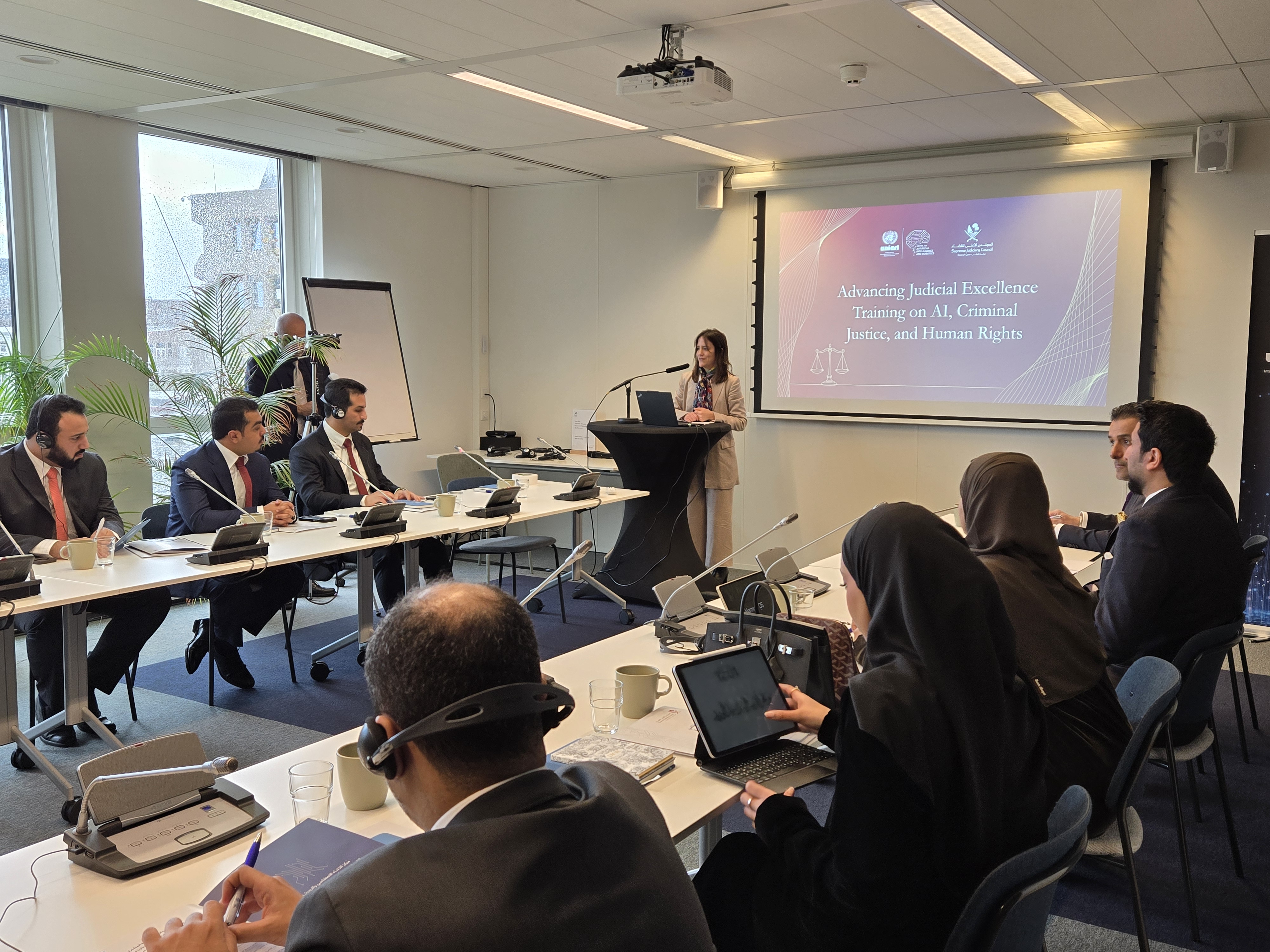
The training titled Advancing Judicial Excellence Training on AI, Criminal Justice, and Human Rights, consists of five-day training sessions hosted and delivered at the UNICRI Centre in The Hague and features:
Structured modules combining conceptual foundations on AI with practical, scenario-based discussions reflecting real judicial challenges associated with data-driven technologies.
Guest lectures by distinguished academic experts, representatives from international organizations, and private-sector actors, offering multi-stakeholder perspectives.
A study visit to the Peace Palace, home to the International Court of Justice, the Permanent Court of Arbitration, and the Hague Academy of International Law, where participants learn about the Palace’s historical significance and its role in global justice.
By equipping judges with the knowledge, tools, and ethical frameworks needed to engage responsibly with AI, the initiative contributes to strengthening the rule of law in an increasingly digital justice environment. It reflects UNICRI’s commitment to supporting judicial institutions in navigating technological transformation while safeguarding human rights, judicial independence, and public trust in justice systems.
 |  |  |