
The Western Balkans strengthened their capacity to address CBRN crimes through a courtroom-based Mock Trial involving Bosnia and Herzegovina, Montenegro and North Macedonia, enhancing preparedness, cooperation and effective judicial responses to complex CBRN risks. The training programme is fully funded by the European Union through the EU CBRN Centres of Excellence Initiative.
CBRN Risk and Scope of the Action
The widespread circulation and potential misuse of chemical, biological, radiological and nuclear (CBRN) materials pose serious risks to security, public safety and the rule of law. Responding to such incidents requires justice systems capable of managing complex investigations, handling technical evidence and conducting proceedings that meet both security and due process requirements.
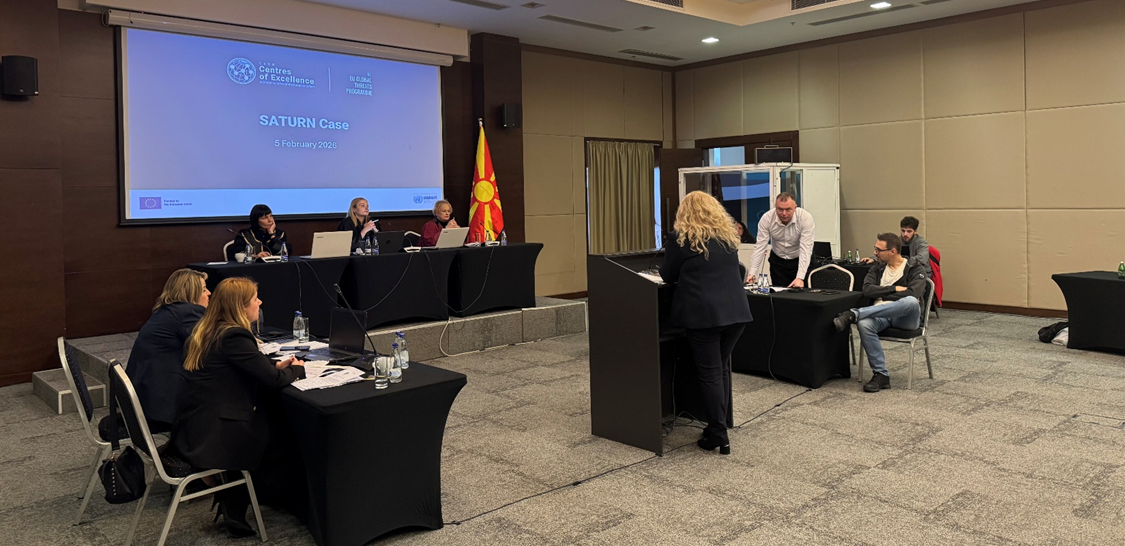
In response to these challenges, the Western Balkans region has taken concrete steps to strengthen preparedness. Bosnia and Herzegovina, Montenegro and North Macedonia engaged in a courtroom-based Mock Trial to enhance national capacities to investigate, prosecute and adjudicate CBRN crimes through hands-on, practice-oriented training aligned with real judicial procedures.
National Ownership and Regional Participation
The action was led by national authorities from Bosnia and Herzegovina, Montenegro and North Macedonia, with Montenegro hosting the exercise in Podgorica from 3 to 6 February 2026. Prosecutors, judges, investigators, law enforcement officers and forensic experts from the three countries participated, reinforcing strong national ownership while fostering regional cooperation.
The Mock Trial was developed within the framework of the European Union’s CBRN Risk Mitigation Centres of Excellence Initiative, in collaboration with the United Nations Interregional Crime and Justice Research Institute (UNICRI).
Operational Impact and Capacity Development
The Mock Trial strengthened judicial and investigative capacities through realistic chemical, biological and radiological/nuclear case scenarios embedded in national legal frameworks. By assuming both prosecutorial and defence roles, participants enhanced their understanding of evidentiary standards, procedural safeguards and courtroom dynamics, while improving coordination among investigative, prosecutorial and judicial actors. The exercise reinforced national authorities’ ability to manage complex CBRN cases from crime scene to courtroom.
The Mock Trial represented the final phase of a four-part capacity-building programme, which also included a Tabletop Exercise, a CBRN Criminalisation Workshop and a module on Building a Case for Prosecution. A total of 39 participants completed the full training pathway and received certification. To support sustainability, a Train-the-Trainer programme will be launched to enable selected national instructors to deliver future courses domestically and institutionalise specialised CBRN expertise.
International Uptake and Broader Impact
The success of this pilot initiative has generated significant international interest, with 17 countries formally requesting access to the training modules to replicate the methodology within their own legal and institutional frameworks. By applying a bottom-up, context-specific approach, the EU CBRN CoE Initiative supports the development of sustainable and nationally owned capacities. Through legislation-aligned, practice-based training for judicial and investigative professionals, the Mock Trial and the wider programme contribute to strengthening coordinated responses to CBRN crimes and enhancing global preparedness against evolving CBRN threats.
This action was implemented with the financial support of the European Union through the EU CBRN Centres of Excellence Initiative. The training forms part of a broader EU CBRN CoE project aimed at strengthening national and regional capacities to prevent, investigate, and prosecute CBRN crimes by enhancing legal frameworks, operational coordination, and judicial expertise.
To know more: EU Global Threats Programme – EU CBRN Centres of Excellence Initiative


